

• Skip to primary navigation
  • Skip to main content

Georgia Forestry Association #1 Forestry State in the Nation

  • Connect
    • Landowner Outreach Program
    • News & Views Blog
    • Please Print This Podcast
    • Find Forestry Experts
    • Georgia Forestry Magazine
    • Carbon101
  • Advocate
    • Hurricane Helene Policy Resources
    • Forestry Equipment Referendum Campaign
    • Private Property Rights
    • Sensible Taxes and Regulation
    • Healthy Markets
    • Center for Forest Competitiveness
  • Attend
    • Events Calendar
    • 2026 Annual Conference
    • 2026 Forestry Day at the Capitol
    • Regional Forestry Meetings
    • Georgia Landowner Summit
    • Forestry in Focus
    • 2020 American Forestry Conference
  • Grow
    • ForestPAC
    • Forest Resource Teams
    • License Plate
    • Emerging Leaders
    • Assured Partners: Outdoor Insurance Program
    • Redfin Polarized Sunglasses
  • Foundation
  • About Us
    • #1 Forestry State
    • Vision & Core Principles
    • Leadership
    • Staff
  • My Account
  • Join
  • Contact
  • Search Toggle
  • Skip to content

State-Level Priority Issues for the Forestry Community in Georgia

Following the 2016 Annual Conference and Forestry Expo, and as the Association looks to close out its calendar year, the GFA legislative team has remained focused on protecting forestry assets and businesses in Georgia, connecting members with resources and relationships, and empowering them for the future. The following issues are critical to the forestry community in Georgia, and therefore are a priority for the Association’s advocacy efforts.

78ec117f-e108-4821-b89b-f1c533e755cb

Local Bans on Wood as a Construction Material

Background:

Following the lead of Dunwoody and Chamblee, the north Atlanta city of Sandy Springs recently passed a building code amendment that proposed a code amendment that requires developers to use steel or concrete materials in any building or structure over three stories and exceeding 100,000 square feet. This will effectively ban the use of wood in those types of buildings. Despite GFA’s meetings with Sandy Springs Mayor Rusty Paul, letters to the city council and a testimony provided at the city council meeting, the amendment was passed.

Current Status:

Now three northern metro Atlanta cities – Sandy Springs, Dunwoody and Chamblee – have passed ordinances limiting the use of wood in commercial construction, and there are rumors that several more are considering similar legislation. GFA is highly focused on developing a strategy to address the issue from a statewide perspective, limiting cities and municipalities from creating such product bans. Until a more solidified strategy is determined from a legislative perspective, the Association is working to utilize the opportunity to educate business, political and community leaders about the safety, performance and sustainability of wood as a building product – and the importance of working forests to metro Atlantans. GFA will continue to provide updates and opportunities to take action as this issue progresses.

Forest Land Protection Act (FLPA) Amendments

Background:

In November 2008, the GFA’s successful constitutional amendment campaign made effective the Forest Land Protection Act of 2008 (HB 1211). The legislation lifted a huge tax burden from Georgia’s forest landowners, creating a property valuation classification of forestland to expand the conservation use valuation assessment program (CUVA) created in 1990. According to the Department of Revenue (DOR), in 2015, there were more than 9,000 parcels in 140 counties participating in FLPA.

Current Status:

Each year, the state is required to provide local assistance grants to counties, school boards and cities to offset a portion of the property tax revenue lost from FLPA. Land in the program is valued using the same conservation use tables established by DOR, and land values cannot increase by more than three percent annually. The law, a constitutional amendment, also provides a specific formula for calculating the assistance grant payments to the counties by requiring the use of 2008 as the base year for fair market value of forest land as a starting point. Under the law, no government entity may decrease that value of forestland without enactment and ratification of a constitutional amendment. However, in July, DOR announced that it would change the formula for calculating forestland fair market value, which resulted in a reduction to the grants provided to certain counties, school boards and cities.

After a letter was sent by Rep. Gerald Greene to Attorney General Sam Olens asking for an official opinion on the constitutionality of the administrative change, DOR reversed its course and announced that it would continue to calculate forestland value as directed by law.

Although DOR reversed course, the State remains concerned with the formula for calculating grant payments. GFA is aware of discussions to amend FLPA to address these concerns. Stay tuned! This issue will continue to be a very high priority for GFA.

Georgia Forestry Commission Equipment Bonds

Background:

The Georgia Forestry Commission (GFC) has many responsibilities, but its most critical mission is protecting the state’s 22 million acres of private, commercially available forestland against destruction from fire and disease. In order to achieve this mission, GFC depends on heavy equipment and aircraft to detect, access and suppress fires. Unfortunately, the agency is well behind on its schedule to replace equipment and is in need of funding to support mission-critical services.

Current Status: 

Compared to Florida, the GFC has twice as many privately forested acres (22 million versus 11 million) but operates with nearly 40 percent fewer firefighters (380 versus 630). While both state forestry commissions have the same number of equipment pieces to fight wildfires (375), each piece of equipment in Georgia covers an average of 59,350 acres of privately owned forest per unit as compared to 29,860 acres of privately owned forest per unit in Florida. Simply stated, Georgia’s citizens may be proud that across the Southeast, GFC is one of the most cost-efficient and streamlined forestry agencies. However, we cannot jeopardize the timber asset that supplies nearly 13 percent of the state’s manufacturing sector by continuing to neglect the Commission’s equipment needs. GFC needs strong support from our legislators and the Governor to provide funds that will allow the Commission to begin renewing its fleet.

Pipeline Study Commission Finalized

Background:

Passed by the Georgia General Assembly and signed by Georgia Governor Nathan Deal earlier this year, House Bill 1036 established a moratorium on petroleum pipelines in Georgia until July 2017, suspended the use of eminent domain powers for a private company, and created a study commission to review the future use of eminent domain and the environmental impacts of pipelines. According to the law, the State Commission on Petroleum Pipelines should include:

  • three members of the State House of Representatives appointed by the Speaker of the House;
  • three members of the State Senate to be appointed by the President of the Senate;
  • the director of the Environmental Protection Division of the Department of Natural Resources or his or her designee;
  • the commissioner of community affairs or his or her designee; and
  • five members to be appointed by the Governor, including one member who shall represent the petroleum industry and four members who shall represent a cross section of the interests of local government, business, agriculture and conservation.

Current Status:

Pursuant to HB 1036, Governor Deal recently finalized appointments to the Commission, which is responsible for recommending changes to the way the state evaluates petroleum pipelines. The commission has until Dec. 31, 2016, to hold a maximum of five hearings to “conduct a detailed study to ensure the exercise of eminent domain powers by petroleum pipelines is carried out in a prudent and responsible manner consistent with this state’s essential public interests.”

Event dates are set for:

  • Thursday, October 20
    Savannah, GA | Armstrong State University Center
  • Thursday, November 3
    Augusta, GA
  • Thursday, November 17
    Atlanta, GA

Members of the Commission include:

  • Ryan Chandler
    Vice President, Colonial Group
  • Robert Ramsay
    President, Georgia Conservancy
  • Wade Hall
    President and CEO, Stuckey Timberland, Inc.
  • Brian Nipper
    President of Nipper Construction Company, Inc., and Mayor of the City of Odum
  • Mike Clanton
    Vice President of Land Department,
    Georgia Power
  • Bill Hitchens, R-Rincon, co-chair
  • Barry Fleming, R-Harlem
  • Al Williams, D-Midway
  • Rick Jeffares, R-McDonough
  • Jack Hill, R-Reidsville
  • Frank Ginn, R-Danielsville
  • Richard Dunn, Director, Environmental Protection Division (or his designee)
  • Camila Knowles, Commissioner, Department of Community Affairs (or her designee)
One Year Later: How House Bill 790 Has Improved Timber Security in Georgia

Since 2014, the Georgia Forestry Commission (GFC) has made a significant impact on the way that timber security issues are investigated. Last year, the Georgia Forestry Association (GFA) in partnership with several public and private organizations last year spearheaded the passage of House Bill 790 to modernize statutes addressing timber theft and timber trespass.

GFC Chief of Law Enforcement Brian Clavier says the agency has not taken its new responsibility lightly. Since July of 2014, GFC has spent more than 2,600 hours investigating 154 complaints. Of those complaints, 12 charges have been filed as a result of GFC investigations and $123,129 has been recovered for landowners.

“The Georgia Forestry Commission, the state, and Georgia forest landowners are very serious about ensuring that all timber harvests comply with the law,” Clavier said. “We will vigorously pursue anyone who violates these laws.”

Before HB 790, many landowners whose timber had been taken without their permission were sometimes met with a less than satisfactory response from local law enforcement. Georgia followed the lead of surrounding states and assigned a dedicated agency to investigations of timber loss.

In addition, HB 790: increased the recovery available to victims from single to treble (or three-times) damages; gave landowners tools to shield themselves from liability when conducting timber harvests; required that mill scale tickets are returned to the seller within 20 days; and, established a four-year statute of limitations for filing complaints related to the unauthorized taking of timber.

“It is important for the economic and environmental sustainability of Georgia’s working forests that bad actors in the timber industry are caught and prosecuted to the fullest extent of the law,” GFA President Andres Villegas said. “We applaud the work of the Georgia Forestry Commission in serving our landowners timber security concerns.”

TimberTheftReward
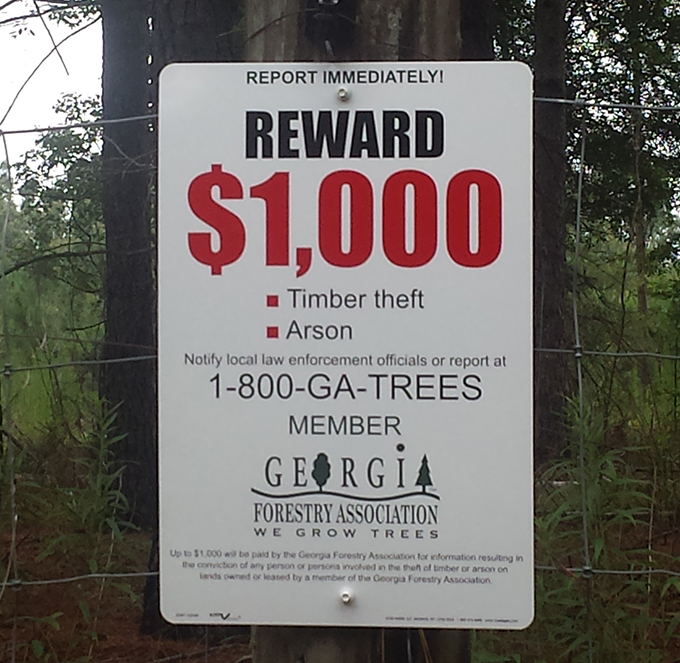
A GFA timber theft reward sign on a member landowner’s property in South Georgia.

Following the signing of HB 790, GFA reinstated its timber theft reward program to provide greater security to members concerned about protecting their timber assets. The Association’s timber theft reward program aims to increase awareness of the new law, while offering a $1,000 reward to individuals who offer information leading to the arrest and conviction of individuals convicted in cases of timber theft or timber arson.

GFA encourages its members to participate in the program by purchasing signs to display on property boundaries. The signs are $14 each for aluminum and $8 each for plastic. For more information, contact Michele Dunham at 478-992-8110 or at michele@gfagrow.org.

According to GFC’s law enforcement division, landowners with complaints about actions affecting their timber should follow three specific steps:

  1. First, attempt to resolve the situation with all parties involved.
  2. If that fails or if the harvesting parties are unknown, landowners should record all known information including contracts, dates, names and contact information for other parties involved and anyone who has knowledge of the events.
  3. Once that information is obtained, the landowner should report the incident to the local Georgia Forestry Commission office.

For more information on timber security, visit www.gatrees.org or contact GFC’s Law Enforcement Division at 1-800-GA-TREES (428-7337) or enforcement@gfc.state.ga.us.

Georgia Forestry Commission Holds Public Comment Period for Updated Timber Harvesting Activity Form

House Bill 199 amended Georgia Code 12-6-24 to enhance the Timber Harvest Notification Process. Among the many positive changes in this code was the need to update and revise the current Notice of Timber Harvesting Activity Form. The updated form which will go into effect July 1, 2015 may be downloaded here.

In accordance with the Administrative Procedures Act, GFC will hold a 30-day public comment period beginning June 16, 2015. Anyone wishing to provide feedback on the updated Notice of Timber Harvesting Activity Form may do so via email to GFC’s Management Department Chief, Gary White, or in person at one of the following public hearings.

July 6, 2015
5:00 p.m. – 6:00 p.m.
GFC Dawson County Unit
4500 Highway 53 East
Dawsonville GA 30534

July 7, 2015
5:00 p.m. – 6:00 p.m.
GFC Chattahoochee District Office
187 Corinth Road
Newnan, GA 30263

July 8, 2015
5:00 p.m. – 6:00 p.m.
GFC Putnam/Greene/Hancock Unit
2200 Centennial Church Rd
White Plains, GA 30678

July 13, 2015
5:00 p.m. – 6:00 p.m.
GFC Satilla District Office
5003 Jacksonville Highway
Waycross, GA 31503

July 14, 2015
5:00 p.m. – 6:00 p.m.
Worth County Agricultural Center
102 Rebecca Drive
Sylvester, GA 31791

July 15, 2015
3:30 p.m. – 4:30 p.m.
Soperton Public Library
585 Second Street
Soperton, GA 30457

Georgia counties or municipal governing authorities may craft ordinances which require landowners or timber buyers to give notice prior to harvesting timber. This can ensure that counties can track ad valorem taxes as well as roadway access points to meet their regulations. Georgia Code 12-6-24 does not preclude counties, municipalities, and other political subdivisions from enacting and enforcing tree ordinances, landscape ordinances, or streamside buffer ordinances; provided, however, such ordinances shall not apply to timber harvesting that is not associated with development.

Please convey any concerns about county ordinances by contacting GFC’s Water Quality Staff. To learn more and to find counties that have passed timber harvest ordinances as of November 2012, click here.

The Macon Telegraph: New law to crack down on timber theft

Stealing timber from a landowner is not like stealing a car. It could take 20-plus years for fully grown trees to be replaced.

But prior to a Georgia law that went into effect July 1, owners of timberland had little recourse if trees were intentionally or — more likely — unintentionally cut from the wrong property, said Matt Hestad, communications coordinator with the Georgia Forestry Association.

Also, cases in which loggers or others in the timber industry took advantage of unsuspecting landowners often were not fully investigated or prosecuted.

“Of course, stealing timber was a crime, but one of the huge problems we saw was that our landowners had nowhere to go in case of timber theft,” Hestad said.

Local county sheriff’s deputies would be called, but often they had more serious crimes to handle — sometimes with limited resources and officers — and “timber theft investigations came in at the bottom of the list,” Hestad said.

But the Timber Security Law gives the Georgia Forestry Commission more investigative and arresting power in cases of unauthorized timber harvest, much like its authority in cases of timber arson. The commission’s officer will continue to work with local law enforcement.

“(Forestry officers) know where the mills are located. They have a one-on-one connection with timber landowners (and) the loggers,” Hestad said. “They are involved with the community, and … if timber gets stolen, they know what could have happened … and they are well-equipped to deal with it. We wanted them to have the authority to investigate and make arrests.”

It’s hard to say yet what impact the new law will have, said Brian Clavier, associate chief of forest protection and chief of law enforcement for the Georgia Forestry Commission.

Read more at www.macon.com

Georgia House of Representatives Approves Timber Security Legislation

The Georgia House of Representatives approved House Bill 790 on a 169-2 vote yesterday. This marks the first step to provide better recourse and recovery for owners of timberland in Georgia who are victims of timber theft and timber trespass. The bill currently awaits action in the Senate.

The legislation, sponsored by Rep. Chuck Williams, R-Watkinsville, is aimed at improving the resources available to timberland owners who are the victims of timber theft. The centerpiece of the bill would give the Georgia Forestry Commission (GFC) law enforcement authority in incidents of timber theft that it currently has in cases of timber arson.

“Timber theft is not an epidemic in this state,” GFA President Steve McWilliams said. “However, you cannot replace trees that have been growing for 20 to 30 years overnight. This bill helps Georgia’s landowners by giving them an opportunity to recover, not only the cost of the timber, but the long term investment lost when trees are stolen.”

The bill includes several other provisions to discourage timber theft and to protect landowners in cases of timber theft or trespass by:

  • Increasing damages for unintentional trespass that result in the unauthorized cutting of timber from the current “one times the value” of the timber to three (treble) times the value.
  • Allowing punitive damages for landowners in addition to treble damages for trees taken in cases of intentional trespass.
  • Requiring that scale tickets on unit sales be returned to original seller within 20 days. Failure to provide tickets within the required time limit would be a misdemeanor.
  • Establishing the statute of limitations for civil actions related to unauthorized timber cutting at four years.
  • Providing landowners some relief from liability in civil cases involving timber trespass by allowing – though not requiring – adjacent landowners to sign a good faith agreement indicating the location of the property lines. A copy of the signed agreement would then be given to the third party timber harvester.

This legislation is the result of hearings held last year by the House Study Committee on Timber Security appointed by House Speaker David Ralston, R-Blue Ridge, following the passage of House Resolution 644 in 2013.

# # # 

About the Georgia Forestry Association (GFA):
GFA exists to conserve and protect Georgia’s private woodlands and forest product industries. GFA acts as the “voice of forestry” working to educate business, environmental and political leaders about Georgia’s responsible forest management practices, benefits derived from forestry, and landowner rights. GFA is headquartered in Forsyth, Ga.

GFA Logo
  • Facebook
  • Twitter
  • Instagram
  • Linkedin
478-992-8110
info@gfagrow.org
Forsyth, GA