

 Georgia’s forests are under more pressure than they have faced in a generation. A wave of mill closures, the lingering damage from Hurricane Helene, and a softening in traditional pulp and paper demand have squeezed markets, which has impacted the entire state and no sector of the Georgia forestry community has been left untouched.
From the very beginning, the Georgia Forestry Association (GFA) and the Georgia Forestry Foundation (GFF) staff and leadership have laser focused on driving initiatives that support investment and growth in existing and new markets for wood. From lawmakers and academic leaders to business and sustainability leaders, GFA and GFF has built a strategy and coalitions to strengthen market access, attract new investment, and protect the long-term viability of Georgia’s 22 million acres of private working forests.
Policy and Advocacy: Winning Where It Counts
When the General Assembly convened, GFA brought a clear, market-first agenda — and delivered.
The Governor’s Forestry Task Force. After Governor Kemp charged the Georgia Forestry Commission with convening a statewide Forestry Task Force, GFA was fortunate to have seat at the table alongside the Department of Agriculture, the Department of Economic Development, UGA’s Warnell School, Georgia Tech, the Technical College System of Georgia, and Georgia’s Rural Center. The Task Force delivered its recommendations to the Governor’s office, laying out short- and long-term priorities for policy, investment, and coordination — and giving the industry’s market challenges the visibility they deserve at the highest levels of state government. The report from the task force, published by the Georgia Forestry Commission was key to driving much of the Association’s advocacy efforts in the 2026 legislative session.
Political support and engagement. In addition to the Governor’s Task Force, legislative leaders from across Georgia moved quickly to better understand the economic environment facing the forestry sector and identify how public policy could support its mid- and long-term recovery. At the direction of House Speaker Jon Burns, the House Rural Development Council convened forestry and business leaders to discuss the challenges facing the industry and the opportunities to strengthen markets and attract new investment. That meeting—and the continued engagement of legislative leaders—helped lay the groundwork for the forestry policy priorities advanced during the 2026 legislative session.
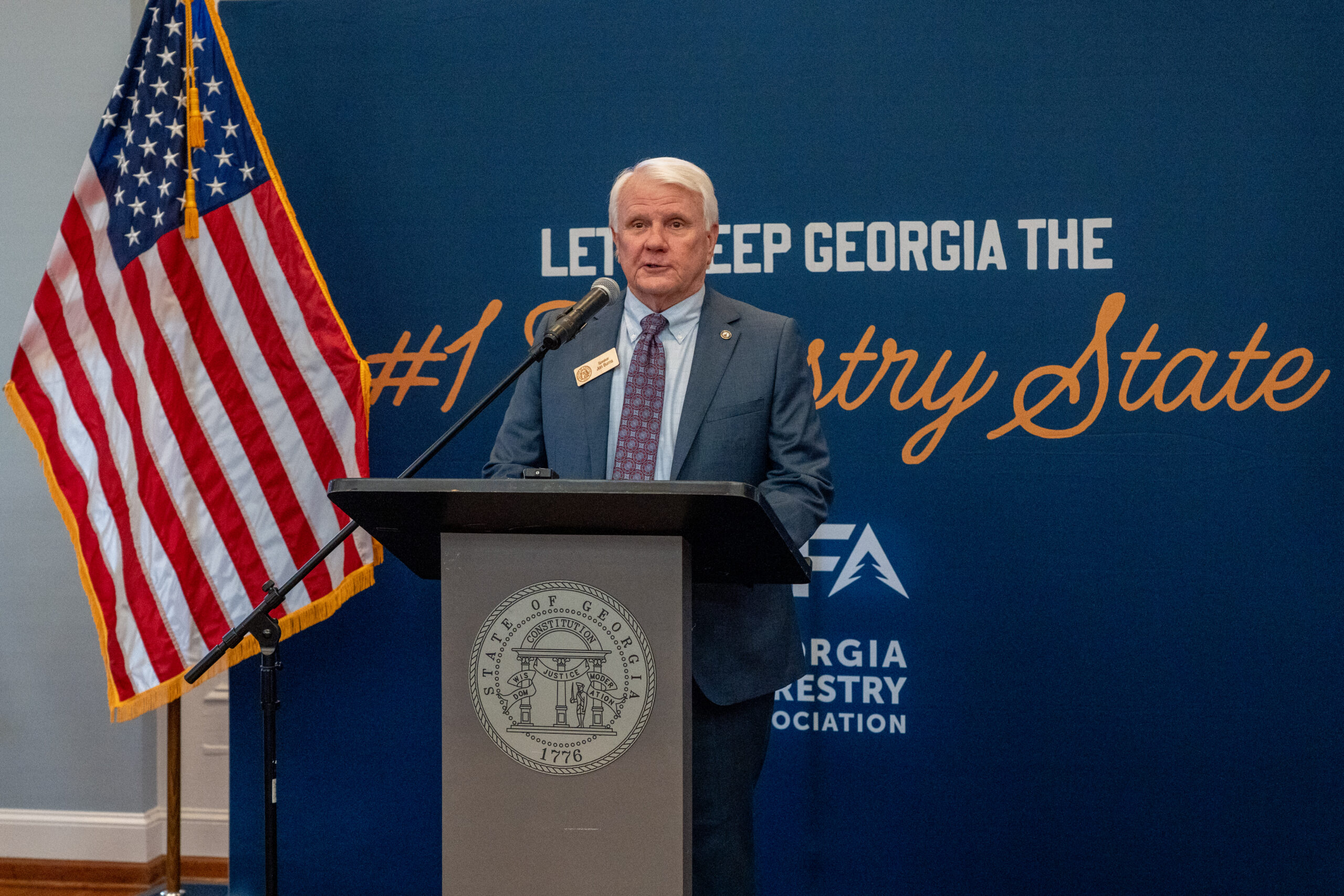
Speaker Jon Burns speaks at GFA’s Forestry Day at the Capitol on February 10, 2026.
The Keep Georgia Forested Act (HB 134). Signed into law at GFA headquarters in Forsyth and effective July 1, 2026, HB 134 is the most significant forestry economic-development measure to clear the General Assembly in years. The law makes Georgia’s existing Jobs Tax Credit and Investment Tax Credit transferable for qualified forestry manufacturers — a practical, proven tool that helps the state recruit new manufacturing investment, put capital to work faster, and accelerate hiring in the rural communities that depend on forestry most.

Chairman Jesse Petrea (R-Savannah) carried HB 134 in the Georgia House of Representatives.

Gov. Kemp signs HB 134 at the Georgia Forestry Association Headquarter on May 6, 2026
State budget priorities. GFA’s advocacy also helped secure direct state investment in forestry’s future. Two key items in Governor Kemp’s budget proposal, which was ultimately approved through the legislative process, are key to the future of the forestry sector in Georgia:
- Georgia Forestry Innovation Initiative: Included in the amended FY2026 budget at $8.9 million, this initiative pairs the Georgia Forestry Commission with Georgia Tech’s Renewable Bioproducts Institute to turn low-value wood and mill byproducts into high-value biomaterials – including platform chemicals for pharmaceutical solvents and high-performance chemicals and also hard carbons for battery production.
- Georgia Grown Wood Products Initiative: A $370,000 investment to expand the Georgia Grown Wood Products marketing and communications campaign. In the 2025 legislative session, a $200,000 investment formed the partnership with the Georgia Department of Agriculture’s Georgia Grown program, Georgia Forestry Commission and GFA to build a brand direction, website and marketing strategy for the intiative. The second phase equips state and local economic developers with a Forestry Investment Toolkit and sector prospectus, engages investors through targeted outreach, and sustains year-round awareness through earned media — keeping Georgia competitive as other Southern states chase the same manufacturing investment.
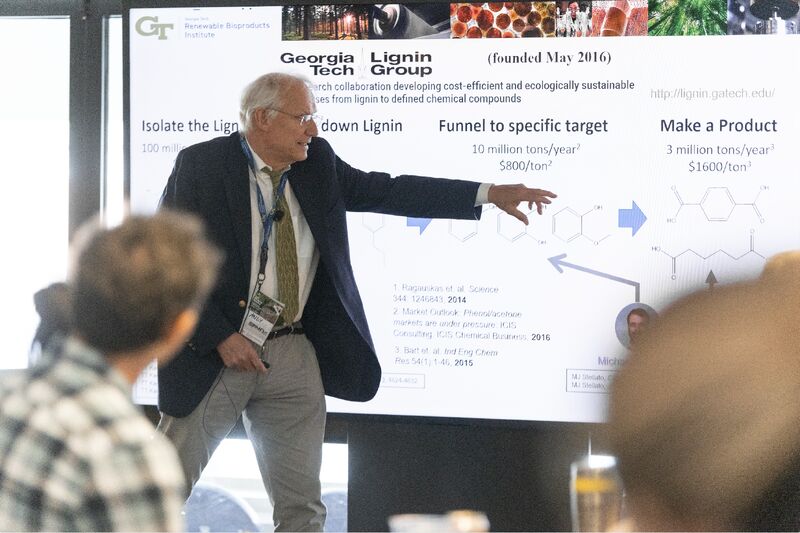
Andreas Bommarius presenting at the Georgia Tech RBI Conference on the Georgia Forest Innovation Initiative.
Coalitions and Engagement: Building Markets Beyond Georgia
Healthy markets don’t stop at the state line, and neither does GFA’s engagement.
Expanding export markets. GFA and its members are working to open new outlets for Georgia wood, with an additional 1 million tons of export-driven demand expected by the end of 2026.
GFA is also supporting federal efforts to remove trade barriers, including EU approval of sulfuryl fluoride treatment for Southern Yellow Pine exports. Speaker Jon Burns joined House Speakers from six other Southeastern states in urging White House action. The EU review is advancing, with a draft opinion expected in fall 2026 and a final decision anticipated in winter. An EU technical specialist will visit Savannah in September ahead of continued U.S.–EU discussions.
Sustainable Aviation Fuel (SAF). In partnership with the Metro Atlanta Chamber and state business and civic leaders, GFA is helping position Georgia as a national leader in SAF — a high-value emerging market built on the state’s abundant woody biomass. With major players like Delta and LanzaJet’s Freedom Pines facility in Soperton already in motion, SAF represents a genuine opportunity to connect urban demand with rural supply and create new value for forestry residues.
Economic Development Support. GFA has played an active role in supporting early-stage forest product and bioeconomy companies as they evaluate opportunities to locate, expand, or invest in Georgia. This work has included providing funding support letters, making strategic connections to the Georgia Department of Economic Development, state policymakers, local economic development authorities, research partners, and industry leaders, and helping companies better understand Georgia’s forest resource base, infrastructure, workforce, and policy environment.
Through this support, GFA has helped emerging businesses navigate key development questions around site selection, feedstock availability, permitting, utility needs, transportation logistics, market access, and public-sector incentives. These efforts have included companies exploring domestic bioenergy technologies, liquid biofuels, engineered wood products, biobased materials, and other next-generation uses for Georgia-grown wood and forest residuals.
Events and leadership. GFA and GFF leaders are carrying Georgia’s story into the rooms where capital and policy decisions get made, including the BlackRock Infrastructure Conference, the US Endowment for Forestry & Communities Markets Matter Convening, the Georgia Economic Developers Association Conference, the UGA Environmental Policy Academy, the Super South Conference, the Wood Bioenergy Conference, and the Panel & Engineered Lumber International Conference & Expo (PELICE).
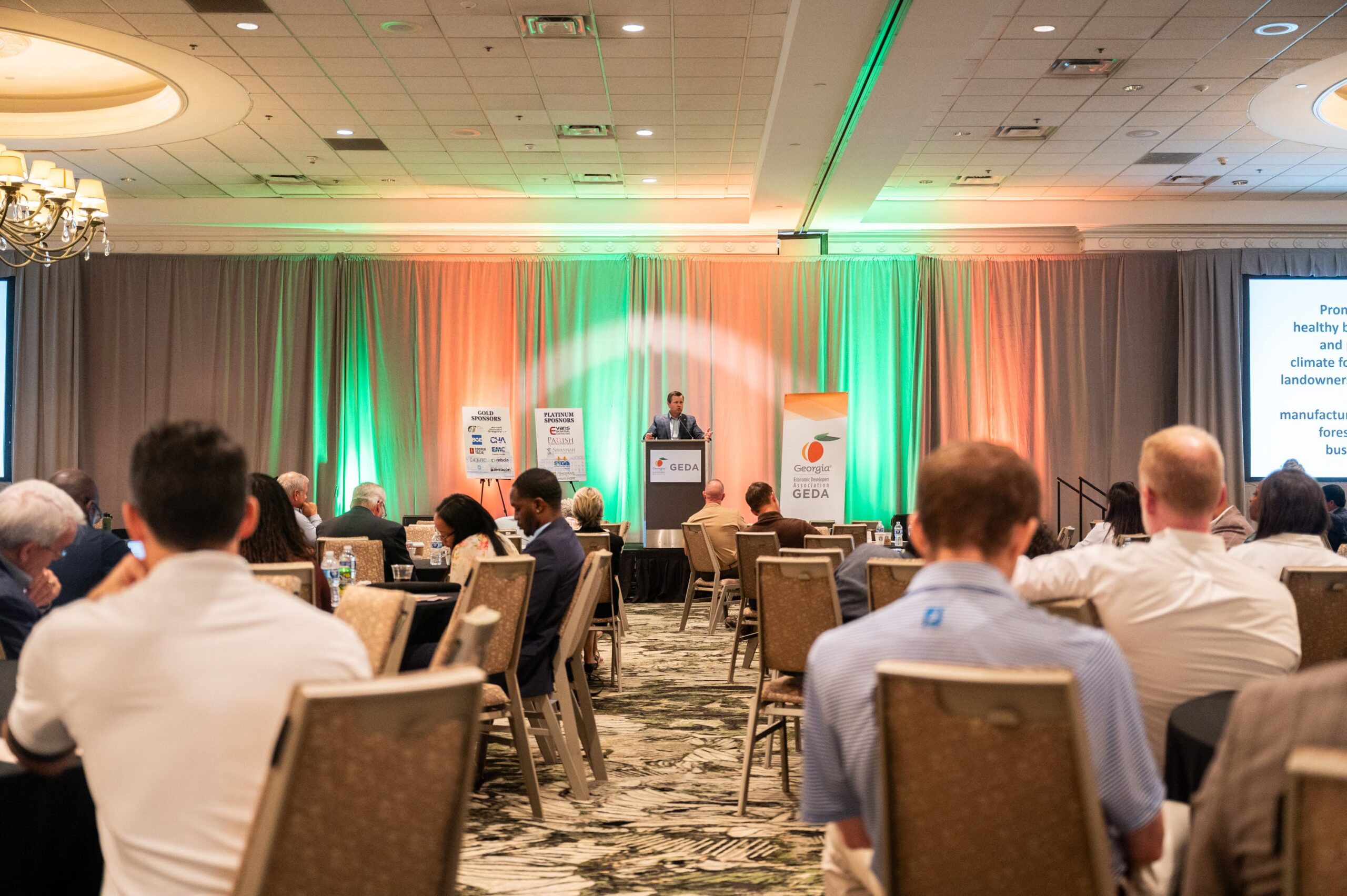
GFA President & CEO Tim Lowrimore presents at Georgia Economic Developers Association Conference in April 2026
GFF Market Activation: Turning Strategy Into Shovels in the Ground
While GFA drives policy, the Georgia Forestry Foundation is activating markets directly — funding research, building demand, and bringing new products to life.
Driving Forest Product Manufacturing Innovation. With support from the Richard King Mellon Foundation, the Georgia Forestry Foundation is launching the Georgia Forest Products Innovation Accelerator to build the market conditions needed for next-generation wood products to scale in Georgia. This initiative will focus on turning promising forest-based technologies into investable opportunities by aligning research, feedstock analysis, communications, policy support, and investor engagement. Through market and siting analysis, stakeholder convenings, targeted communications, and a business accelerator support for early-stage innovative forest products, GFF will help create new pathways for low-value wood fiber — including thinnings and mill residuals — to become higher-value products that strengthen rural economies and keep Georgia’s working forests working.
Growing Awareness of Mass Timber Construction. In partnership with the USDA Forest Service and the Softwood Lumber Board, GFF’s Mass Timber Accelerator awarded its current cohort of three projects a combined $75,000 plus expert technical assistance from WoodWorks — supporting residential, educational, and community buildings that showcase the strength and low carbon footprint of mass timber. Statewide, roughly 30 projects are now in some form of development, building a pipeline of demand for Georgia’s southern yellow pine.
Georgia Grown Forest Carbon Project. GFF is partnered with Georgia Tech’s Ray C. Anderson Center for Sustainable Business, UGA’s Warnell School, and Clemson University to build a first-of-its-kind, Georgia-specific forest carbon exchange. The initiative is refining a methodology to grow corporate investment on 60,000 acres of hurricane-impacted lands, connecting small-acreage landowners with buyers seeking high-integrity, locally sourced carbon credits — a new income stream that rewards landowners for keeping forests as forests.
UGA research exploration. Looking further ahead, GFF is supporting UGA’s exploration of biomaterial market development and emerging biomass technologies — the next frontier of value for Georgia’s forest resources. This research will help inform policymakers and energy leaders on how forest biomass compares with other energy sources as Georgia faces rising demand for reliable, affordable and dispatchable power.
A Coordinated Strategy for Working Forests
No single bill, grant, or coalition will carry Georgia’s forests through this moment. What will is a coordinated strategy — and that is exactly what GFA and GFF are executing. By advancing smart policy, building and joining the right coalitions, and activating markets directly through the Foundation, the organizations are pursuing one shared goal: keeping Georgia forests working today while building the markets that will sustain them for generations.
Georgia is the No. 1 forestry state in the nation. Thanks to the support of engaged members and donors, GFA and GFF intend to keep it that way.