

The Georgia Forestry Commission recently released its Spring 2015 Update on Cogongrass in Georgia. In an effort to suppress the spread of the species throughout the state, the Commission will continue to spray the cogongrass at no cost to Georgia landowners.
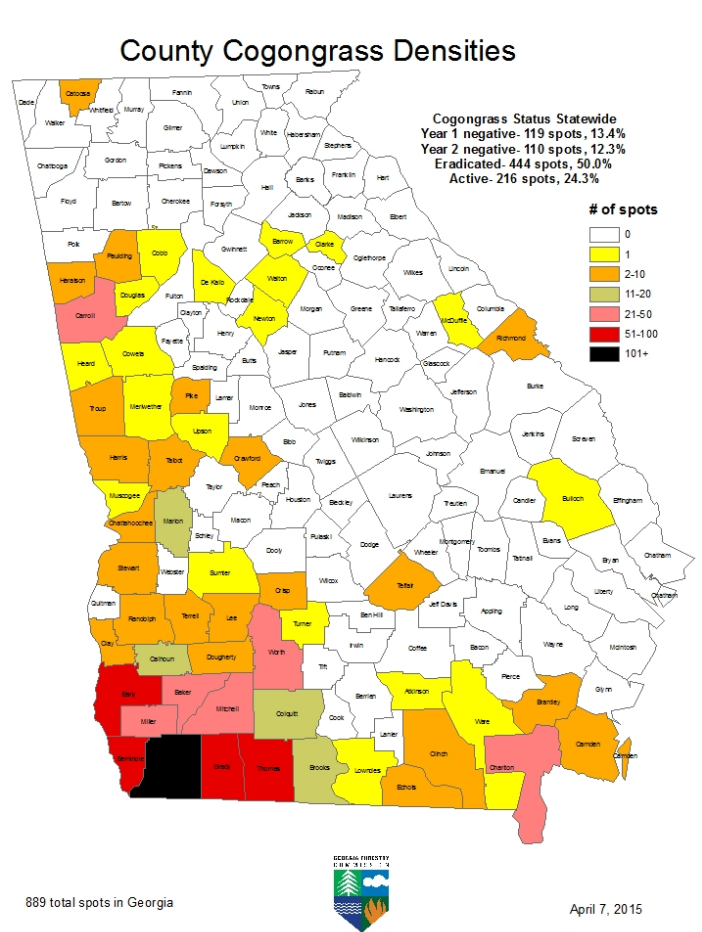
Cogongrass is an aggressive, invasive, perennial grass that is distributed throughout the southeastern United States. Since December 1, 2014 there have been 29 new cogongrass detections in Georgia. As daily temperatures continue to increase, cogongrass will initiate shoot growth and begin flowering very soon. Therefore, landowners are encouraged to survey their property, especially pine woodlands, for the presence of this exotic, invasive grass.
Spring flowering season is the most common time to detect cogongrass infestations. Cogongrass primarily flowers between April and early June. The white, fluffy seed heads are visible from a distance. However, the distinct golden brown coloration in late fall through winter following frost makes cogongrass visible during the colder months of the year. Cogongrass is most difficult to detect during the growing season. However, the most distinguishable feature of cogongrass is its dense, sharp, pointed rhizome root system. Therefore, it is recommended to dig the rhizomes to make a positive identification.
To report a potential new cogongrass detection, contact your local Georgia Forestry Commission (GFC) office or your Regional Forest Health Specialist. Landowner’s are required to sign a spray agreement with the Georgia Forestry Commission to legally allow resource professionals to access the property and spray the identified cogongrass. All positive detections are monitored annually until eradicated.
For more information on the identification and treatment of cogongrass, download GFC’s Spring 2015 Cogongrass Update or visit GFC’s website.
Georgia Forestry Commission Forest Health Specialists
North Region
Lynne Womack
3086 Martha Berry Hwy, NE
Rome, GA 30165
(o) 706-295-6021
(c) 912-515-5180
lwomack@gfc.state.ga.us
Southwest Region
Mark McClure
2910 Newton Rd.
Albany, GA 31701
(o) 229-430-5122
(c) 229-869-8592
Southeast Region
Chris Barnes
5645 Riggins Mill Rd.
Dry Branch, GA 31020
(o) 478-751-3491
(c) 912-601-7093
cbarnes@gfc.state.ga.us