Timber markets are the backbone of Georgia’s forest economy. Across the state, a network of mills buys roundwood and chips based on species, size, and product potential. These wood-using industries turn standing timber into materials that feed Georgia’s forest products sector and the world. Understanding the types of mills that operate nearby helps landowners gauge local market demand, plan harvests, and make informed management decisions.
Local Markets
In Georgia, your local market is determined by the type and proximity of the nearest mills. For example, if you have large trees, but the closest mill is a pulp mill, you may not be able to sell those trees as high-value logs. It’s important to know what mills are in your area so that you can plant and set objectives accordingly. If you live near a pellet mill, you may want to plant more densely so that you can thin sooner. There are a lot of considerations when planting and it is vital to work with a professional who understands the inner workings of your local market.

From Tree to Product: Local Uses & Global Reach

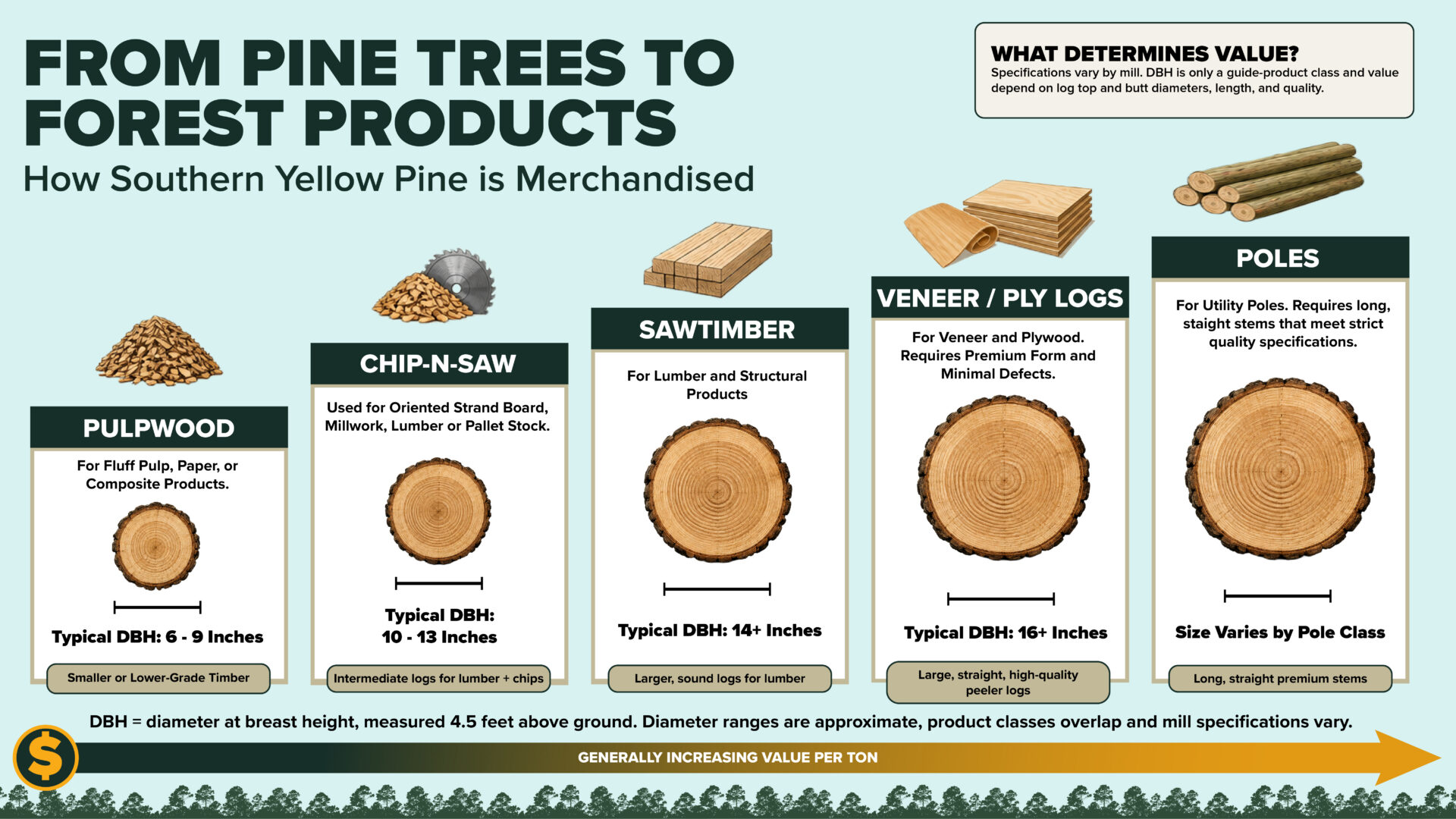
Once a tract is harvested, Georgia’s mill network begins turning that roundwood into a spectrum of products. Saw logs become lumber for homes and commercial buildings; pulpwood is processed into paper and packaging; chips and residues feed panel and engineered wood plants or biomass energy facilities. Secondary manufacturers take mill outputs and turn them into finished goods like flooring, furniture components, pallets, mulch, and wood pellets. Many of these products are consumed within the U.S., and others are exported internationally, contributing to Georgia’s position as a leading forest products exporter.
In today’s global marketplace, wood harvested in Georgia might be manufactured into industrial wood pellets that are shipped overseas and used to heat homes in the United Kingdom, underscoring how a single tree can contribute to local economies and global energy systems alike.
Types of Primary Wood-using Mills
Georgia hosts a diverse range of wood processing facilities that convert harvested timber into primary products, each with specific market purposes.
- Sawmills (Softwood, Hardwood & Mixed): Convert logs into dimensional lumber (framing boards, beams, etc.) and by-products like chips and sawdust used by other industries.
- Pulp & Paper Mills: Process pulpwood and chips into pulp used for paper, packaging materials, and specialty paper products.
- Post & Pole Mills: Manufacture treated or untreated utility poles, fence posts, and similar long, straight wood products
- Panel & Engineered Wood Product Mills: Make plywood, oriented strand board (OSB), and other composite panels used in construction and industrial applications.
- Veneer & Specialty Mills: Peel or slice logs into veneers for furniture and high-grade panel products.
- Energy & Biomass Facilities: Use wood residues or lower-grade material to generate electricity or produce wood energy products (including industrial pellets).
- Miscellaneous: Include mulch, firewood, shavings, and other niche product facilities.
Timber Pricing
TimberMart-South (TMS) is a widely recognized source of current and long-term trend data for stumpage and delivered wood prices and other fundamental forestry business information for the Southeastern USA. TMS publishes quarterly and annual reports used by public and private companies, consultants, landowners, and others to assess market prices in 11 states in the US South. A consulting forester can also help you gauge the return your timber might bring in the local market.

Resources
-
GFA Healthy Markets
Outlines GFA's work to expand demand and market access for Georgia forest products through mass timber, global trade, carbon, and ecosystem-service initiatives.
View Resource -
Georgia Forestry Foundation: Forest Economy
Explains how the Georgia Forestry Foundation supports forest-product demand, supply-chain competitiveness, and workforce development to strengthen Georgia's forest economy.
View Resource -
Georgia Wood-Using Industries Directory
Provides a Georgia Forestry Commission directory of wood-using businesses to help landowners identify potential forest-product markets and industry contacts.
View Resource -
Georgia Stumpage Prices
Provides current quarterly average stumpage prices for major timber products in Georgia.
View Resource -
South-Wide Stumpage Prices
Provides current quarterly average stumpage prices for major timber products across the U.S. South.
View Resource -
Quarterly Price Reports
Offers quarterly reports with timber price data and market analysis for the U.S. South.
View Resource -
2026 Timber Forecast
Reviews recent Georgia timber market conditions and presents the 2026 outlook for key timber products.
View Resource -
#1 Forestry State
Summarizes why Georgia is a leading forestry state, including its forest resources, manufacturing base, jobs, and economic impact.
View Resource -
Healthy Markets
Outlines GFA's advocacy for competitive timber and forest-product markets that sustain private working forests in Georgia.
View Resource -
Forest Economy
Summarizes the economic role of Georgia's forests, forest products, and working forestland.
View Resource -
Wood-Using Industries Directory
Provides a searchable directory of Georgia mills and other primary and secondary wood-using businesses.
View Resource